The Myth of Capricorn: Archetypal Movement with the Sea Goat
Mythic Roots of Capricorn: From Chaos to Form
Capricorn is symbolized by the Sea Goat. The Sea Goat has ancient mythic roots, often associated with the god Pan or with early Mesopotamian deities linked to creation and order. In some tellings, the Sea Goat emerges during moments of chaos, when the boundaries between worlds blur, and survives by adapting, transforming, and remembering its essential nature.
This is important. Capricorn’s myth is not about perfection or cold authority; it is about survival through intelligence, patience, and integration. The Sea Goat does not deny the waters of fear, grief, or longing. It grows a tail and learns to swim. Nor does it abandon the call to climb, to build, to take responsibility. Instead, it learns when to descend into the depths and when to place its hooves carefully on stone.
Mythically, Capricorn is the point where raw experience begins to crystallize into wisdom. It is where time becomes meaningful, where effort becomes devotion, and where instinct is shaped into something enduring.
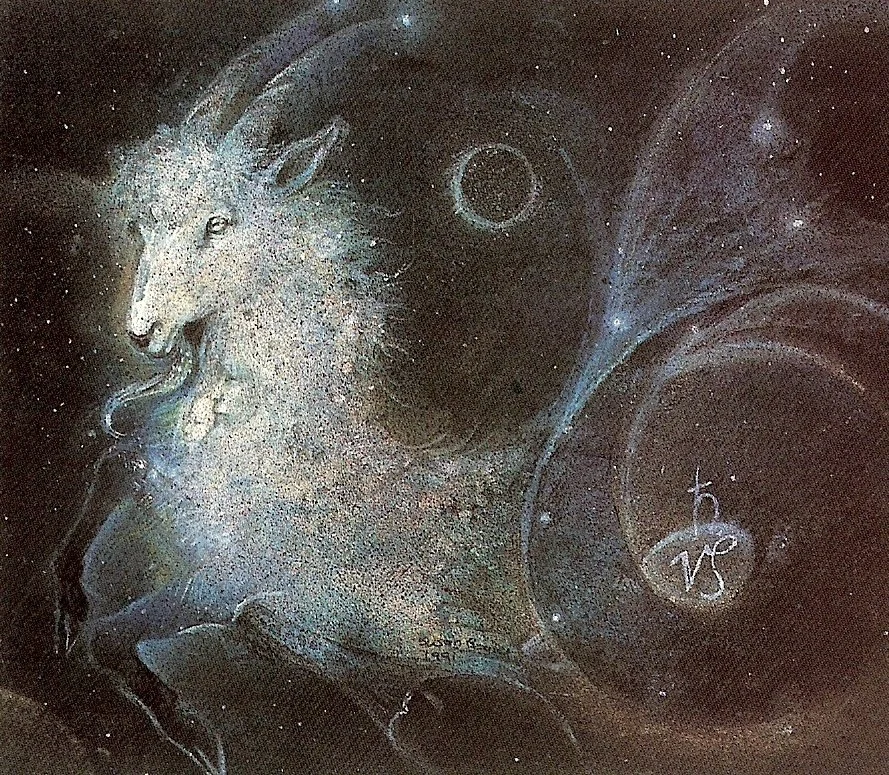
The Story of the Sea Goat
In ancient Mesopotamia, the Sea Goat was associated with Enki, god of water, wisdom, and creation. Enki was a threshold being, governing the meeting of rivers and sea, idea and form. He was depicted with the body of a goat and the tail of a fish, a living symbol of survival through balance, grounded action joined with intuitive knowing.
Later, the Babylonians called this constellation the Great Goat, linking it to the agricultural year and the patient labor that sustains life. It was a creature of reliability rather than spectacle, tied to seasons, nourishment, and endurance.
When the myth traveled to Greece, it became entwined with the story of Pan. As the monster Typhon rose to challenge the gods, Pan fled toward the water. In his fear, the transformation was incomplete: his lower body became a fish, while his upper body remained goat. What appeared to be a mistake became his strength. In this hybrid form, known as Aegipan, he could move between land and sea, instinct and structure.
Aegipan’s strange cry disrupted Typhon long enough for order to be restored. In honor of this adaptability and courage, the Sea Goat was placed among the stars.
Thus Capricorn became a sign of time, responsibility, and earned wisdom. The Sea Goat reminds us that what lasts is built patiently by learning how to stand on solid ground while still remembering the wisdom and memory of sea.
Capricorn and The Devil
The Devil card in Tarot is associated with Capricorn and is a complex and often misunderstood archetype. While popularly associated with temptation, materialism, and shadow, it also carries a deeper, more nuanced meaning when explored in the context of Capricorn and its mythic connections, especially with the god Pan.
Capricorn is ruled by Saturn, the planet of structure, limitation, time, and discipline. In Tarot, the Devil often represents the chains we place on ourselves: attachments, fears, and patterns that limit our freedom. Through the lens of Capricorn, these constraints are not just external but internal, rooted in ambition, responsibility, and the human tendency to overwork or overcontrol.
The Devil card can reflect the tension between the Capricorn desire for mastery, achievement, and the fear of failure or scarcity. It asks us to recognize the structures we have created that both support and restrict us. Like Saturn itself, the Devil embodies a duality: the power of structure to stabilize, and the rigidity that can imprison.
Pan and the Shadow
The Devil card is mythically connected to Pan. Pan is playful, irreverent, and closely tied to primal energy. This connection highlights the Capricorn/Devil tension: the balance between ambition, responsibility, and the wild, instinctual, untamed part of ourselves. Pan’s myth illustrates that surrendering to instinct and natural desires is not inherently destructive. The Devil card reminds us that greed, lust, fear, and control become dangerous only when ignored or repressed. Like Pan, we are called to integrate this energy, recognize its power, and channel it consciously rather than being controlled by it.
Themes for Reflection
When reflecting on the Devil card in a Capricorn context, consider the following:
Attachment vs. Discipline: Where do our ambitions or responsibilities become chains rather than scaffolds?
Shadow Integration: What instinctual, emotional, or primal energies are we avoiding or denying?
Boundaries and Freedom: How can structure serve our growth without limiting vitality?
Play and Earthly Wisdom: How can the wisdom of Pan, the playful, irreverent, wild goat teach us balance?
Archetypal Movement: Dancing Capricorn
Capricorn as Earth + Water
Astrologically, Capricorn is an Earth sign, but its symbol reveals an unmistakable Water lineage. This paradox is central to its archetypal medicine.
Earth without water becomes brittle, rigid, and lifeless. Water without earth becomes uncontained, overwhelming, or diffuse. The Sea Goat teaches us how these elements can cooperate:
Earth offers structure, boundary, pacing, and gravity.
Water brings feeling, memory, imagination, and emotional truth.
In the Sea Goat, water flows through structure rather than against it. Emotion is not something to suppress or drown in; it becomes information that shapes how we build our lives.
The Sea Goat in the Body
Somatically, the Sea Goat invites us to experience ourselves as both fluid and skeletal at the same time.
Bones give us form. They are our inner mountains—quiet, enduring, shaped by time and pressure. Fluids - blood, lymph, cerebrospinal fluid - are our inner seas, constantly moving, responsive, carrying nutrients, sensation, and memory.
In the body, Capricorn awareness asks:
Can you feel your emotional life moving within the support of your bones?
Can you allow structure to hold feeling without hardening against it?
Can gravity be a source of safety rather than collapse?
To embody the Sea Goat is to explore two primary movement impulses: descending and ascending.
Descending: Returning to the Inner Sea
Descending movements are slow, weighted, inward. They invite the body to fold, spiral, sink, and soften.
Somatic explorations:
Let your weight pour downward through your bones into the floor.
Explore bending joints deeply - hips, knees, ankles - like a goat navigating uneven terrain.
Allow the spine to ripple as if underwater, moving vertebra by vertebra.
Notice emotional tone without needing to name or express it outwardly.
This is not collapse; it is listening. Descending allows you to retrieve sensation, memory, and truth from beneath the surface.
Ascending: Shaping Experience Into Form
Ascending movements are deliberate, precise, and directional. They engage balance, alignment, and effort.
Somatic explorations:
Slowly rise from the ground, feeling how bones stack and support one another.
Play with straight lines, angles, and sustained reaches.
Explore climbing motions - hands and feet seeking reliable contact.
Sense how intention travels through your skeleton before movement happens.
Ascending is about commitment. It asks: What am I willing to carry? What am I building with my life energy?
Containment as Care
One of Capricorn’s most misunderstood qualities is containment. Containment is often mistaken for emotional suppression, but in somatic terms, containment is an act of care.
Containment allows feeling to exist without flooding the system. It creates a vessel strong enough to hold complexity over time. Like a riverbank, it gives shape to flow.
The Sea Goat teaches us that tenderness needs structure. Without it, sensitivity becomes exhaustion. With it, sensitivity becomes wisdom.
In movement practice, this might look like:
Allowing emotion to inform movement quality without becoming theatrical.
Staying present with sensation even when it is uncomfortable.
Choosing smaller, more precise gestures rather than cathartic release.
Time, Maturation, and the Long Climb
Capricorn is ruled by Saturn, the planet of time, thresholds, and maturation. The Sea Goat does not rush. It understands that mastery unfolds through repetition and patience.
Somatically, this invites respect for pacing:
honoring limits
building strength gradually
trusting that consistency shapes the body
The climb is not a performance; it is a practice. Each careful step matters.
Integrating the Sea Goat
To work with the Sea Goat archetype is to practice integration:
inner and outer
feeling and form
instinct and responsibility
You might ask your body to show you through your movement:
Where do I need more structure to protect what is tender?
Where do I need more fluidity within the structures of my life?
What long-term vision am I willing to move toward, step by step?
In embodying Capricorn, we learn how to become trustworthy containers for our own lives, capable of holding memory, responsibility, and devotion across time.
